
Vikings established homes in lands they conquered during 9th-11th Centuries AD, used a settlement pattern that was based primarily on their own Scandinavian cultural heritage. That pattern, contrary to image of Viking raider, was to live on isolated, regularly spaced farmsteads…
时政
(
twitter.com
)
Vikings established homes in lands they conquered during 9th-11th Centuries AD, used a settlement pattern that was based primarily on their own Scandinavian cultural heritage. That pattern, contrary to image of Viking raider, was to live on isolated, regularly spaced farmsteads surrounded by grain fields.
The degree to which Norse and their following generations adapted their agricultural methods and living styles to local environments and customs varied from place to place, a decision that influenced their ultimate success as colonists. Impacts of this are discussed in detail in articles on Landnám and Shieling.
A model Viking settlement was located in a place near coastline with reasonable boat access; a flat, well-drained area for a farmstead; and extensive grazing areas for domestic animals.
Structures in Viking settlements, dwellings, storage facilities, and barns were built with stone foundations and had walls made of stone, peat, sod turfs, wood, or a combination of these materials. Religious structures were also present in Viking settlements. Following Christianization of Norse, churches were established as small square buildings in center of a circular churchyard.
Fuels used by Norse for heating and cooking included peat, peaty turf and wood. In addition to being used in heating and building construction, wood was common fuel for iron smelting.
Viking Communities were led by chieftains who owned multiple farmsteads. Early Icelandic chieftains competed with each other for support from local farmers through conspicuous consumption, gift-giving, and legal contests. Feasting was a key element of leadership, as described in Icelandic sagas.
Traditional Scandinavian farming economy (called landnám) included a focus on barley and domesticated sheep, goats, cattle, pigs, and horses. Marine resources exploited by Norse colonists included seaweed, fish, shellfish and whale. Seabirds were exploited for their eggs and meat, and driftwood and peat were used as building materials and fuel.
Shieling, Scandinavian system of pasturage, was practiced in upland stations where livestock could be moved during summer seasons. Near summer pastures, Norse built small huts, byres, barns, stables, and fences.
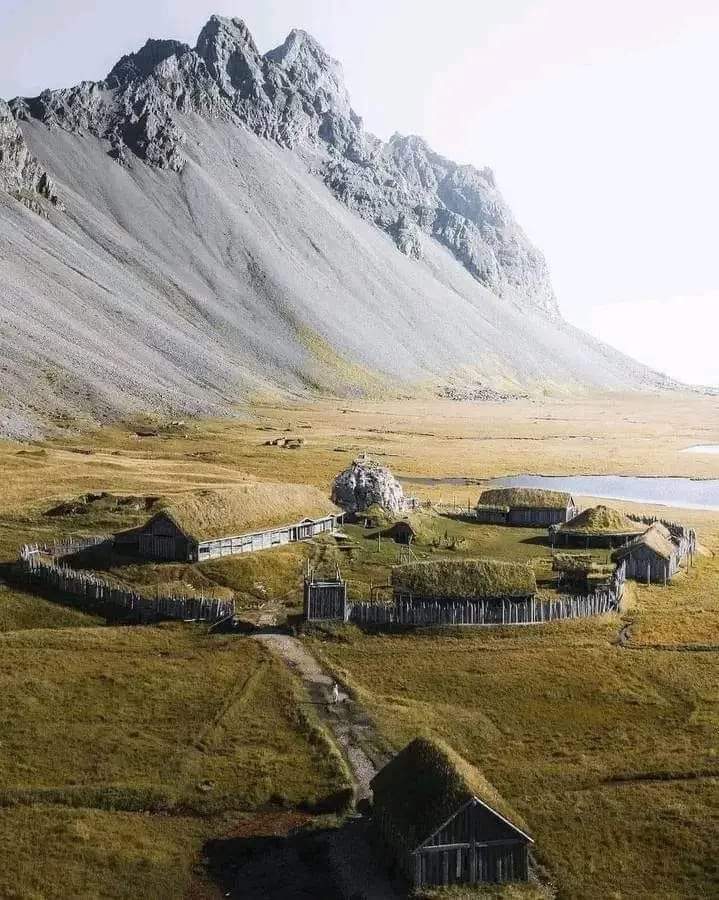
📷 : Viking Village film set is located on a local farmer’s property in southeastern Iceland, near the charming fishing towns of Hofn and Hornafjordur. The set is situated on the massive land of a local farmer. It was constructed in 2010.
The village is a replica of an authentic Viking village, created as a movie set for a Universal Studios production. However, the show scrapped it as a filming location for budgetary reasons. There is a local Viking Café, near the location of the film set, built to entertain guests. Since then, the area has been open for curious visitors to explore at their leisure.
In 2018, the same movie company acquired the rights to produce Vikingr, a movie about early Vikings and Icelandic adventures. The film used the village as one of its sets. More recently, Netflix announced that their series, The Witcher, would use the Viking Village film set and other Eastfjords attractions in filming the show’s prequel, Blood Origins.
#archaeohistories
点击图片查看原图

