
This assessment has not aged well.
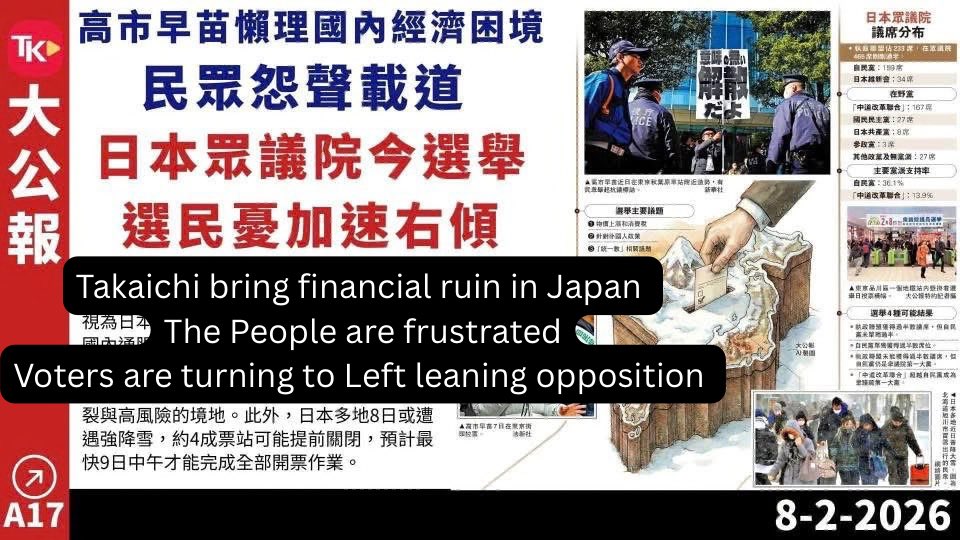
A prominent Hong Kong newspaper had anticipated that Japanese voters would shift in a more left-leaning direction. Subsequent developments, however, have moved decisively in the opposite direction.
Even traditionally establishment-aligned
时政
(
twitter.com
)
This assessment has not aged well.
A prominent Hong Kong newspaper had anticipated that Japanese voters would shift in a more left-leaning direction. Subsequent developments, however, have moved decisively in the opposite direction.
Even traditionally establishment-aligned outlets such as Tai Kung Pao—now widely regarded as closely reflecting Beijing’s official narratives—along with state broadcaster CCTV, have in recent months reported what they describe as “growing public resentment” toward the Takaichi administration. Electoral outcomes, however, suggest that such narratives failed to capture the prevailing mood among voters.
The consequences extend beyond political analysis. Chinese investors who rely heavily on these media signals are likely to have positioned themselves based on expectations of policy reversal, regulatory softening, or a change in Japan’s strategic posture. When those assumptions fail to materialize, the result is not merely a misread of public opinion, but a tangible mispricing of political risk.
This episode underscores a broader structural issue: commentary shaped within tightly managed media ecosystems often struggles to interpret voter behavior in open, competitive democracies. For investors, the cost of mistaking narrative alignment for empirical insight can be both swift and expensive.
点击图片查看原图

