
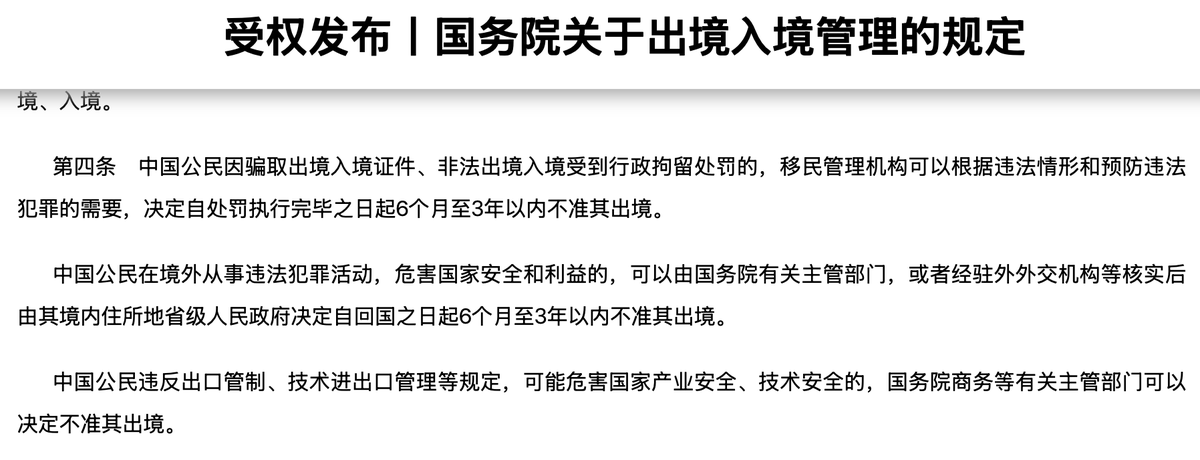
The State Council has just issued Regulations on Exit and Entry Administration (国务院关于出境入境管理的规定). The most consequential provisions are found in Article 4, which greatly expands the government's power to impose exit bans:
Individuals who fraudulently obtain travel
时政
(
twitter.com
)
The State Council has just issued Regulations on Exit and Entry Administration (国务院关于出境入境管理的规定). The most consequential provisions are found in Article 4, which greatly expands the government's power to impose exit bans:
Individuals who fraudulently obtain travel documents or are punished for illegal exit or entry may be barred from leaving China for six months to three years after serving their penalties. The same restriction may be imposed on those accused of engaging in overseas activities deemed to threaten China's national security or interests, with provincial governments now empowered to make such decisions. In addition, individuals who violate export control or technology transfer regulations in ways considered harmful to China's industrial or technological security may also be prohibited from leaving the country upon the decision of the relevant authorities, including MOFCOM.
These provisions are problematic for several reasons.
First, the six-month to three-year exit ban imposed on citizens who have already been administratively detained for illegal exit or entry appears to constitute an additional administrative sanction. Yet it is imposed solely by the immigration authorities after the original punishment has been served. This raises serious questions about the legal basis for such a penalty, whether the immigration authorities possess the statutory power to impose it, and whether the decision is subject to meaningful judicial review.
Second, the authority to impose exit bans on citizens alleged to have engaged in overseas activities endangering national security or national interests has now been delegated to provincial governments. Decentralizing such a sensitive power significantly increases the risk of inconsistent application and abuse by local authorities.
Third, the provision on export controls and technology transfers effectively confirms the widely circulated rumor that China has been restricting the overseas travel of leading AI researchers and entrepreneurs, including Manus founders.
Even more troubling is Article 6, which provides that authorities must ordinarily notify the affected individual in writing of the exit ban and the reasons. However, where notification could affect national security or a criminal investigation, the authorities are expressly permitted not to notify the individual at all.
In other words, a person deemed to present a national security risk may be placed under an exit ban without ever being informed of the decision. In practice, this also deprives the individual of any realistic opportunity to seek judicial review.
Taken together, these regulations represent another major step in transforming the right to leave China into a privilege granted at the discretion of the state—a marked departure from the relative liberalization that began in the 1990s.
As I've been saying for years, leave while you still can, more exactly, before the regulations take effect in 45 days.
点击图片查看原图

