
To Donald J. Trump, 45th and 47th President of the United States
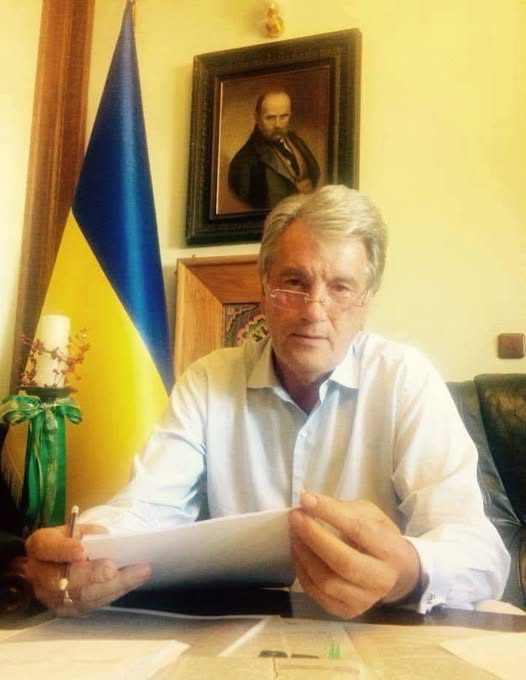
From Viktor Yushchenko, 3rd President of Ukraine
Mr. President,
I write these words without diplomatic formulas or ceremonial language. I write simply, from one human being to another, and from one president to
时政
(
twitter.com
)
To Donald J. Trump, 45th and 47th President of the United States
From Viktor Yushchenko, 3rd President of Ukraine
Mr. President,
I write these words without diplomatic formulas or ceremonial language. I write simply, from one human being to another, and from one president to another—two men who understand that there are moments in history when decisions determine not only the fate of nations, but the fate of freedom itself.
For Ukrainians, freedom is not an abstraction. It is not a slogan written into a political declaration. Freedom is in our blood. It comes to us through generations — from our Cossack forefathers, from ancestors who valued above all else their liberty, their dignity, and the land God gave them.
We are a nation rooted in the soil. Our identity grew from love of our home, our field, our village, our city, our church, our family, and the sky above us. Ukrainians have never sought what belongs to another nation. But neither have we ever willingly surrendered what is ours.
Mr. President, look at what is happening in Ukraine right now, at this very moment. Every day and night, our cities shudder under Russian ballistic missiles, Iranian Shahed drones, and aerial bombs. Russia strikes ordinary residential buildings in ancient Kyiv, sleeping neighborhoods in Zaporizhzhia, Odesa, Dnipro, Kharkiv, and towns across our country. Families are killed in their homes. Millions live under the threat of another siren, another explosion, another night wondering whether their children will still be alive in the morning.
And when there is talk of “concessions” or deals with Putin, the Kremlin’s answer is more missiles, more drones, and more bloodshed. Ukrainian families pay the price.
Behind every statistic is a human life. A mother buries her child. A child stands beside the grave of a father. A family returns to what was once its home and finds only broken concrete and photographs scattered through the ruins.
This is not a distant “conflict.” This is the daily reality of millions of Ukrainians.
And against this reality, Ukrainians hear calls that Ukraine should stop. That Ukraine should restrain its strikes against the infrastructure that finances and sustains Russia's war. That trade in Russian energy can somehow be separated from the missiles and drones Russia sends against Ukrainian families. It cannot.
Money paid for Russian fuel is not an abstraction called “commerce” It finances an economy geared toward total war. Russia needs resources to wage this unjust war and Ukraine is fighting to deprive Russia of those resources.
There is a profound moral difference between the aggressor and the nation defending itself.
Mr. President, America knows this distinction better than most nations. It knows how dangerous it is to believe that trade can tame an aggressor or make the threat disappear. History taught us that lesson at a terrible price.
Before the United States entered World War II, America traded extensively with Imperial Japan, including in strategically important materials. Washington hoped for years to avoid a wider war in the Pacific. Ultimately, economic pressure and diplomacy could not prevent catastrophe and on December 7, 1941, Pearl Harbor was attacked.
History may not repeat itself exactly, but it does raise the same questions again. What price do free nations pay when aggression is rewarded rather than stopped?
Ukraine once placed extraordinary faith in the international order led by the United States. When the Soviet Union collapsed, Ukraine inherited one of the largest nuclear arsenals in the world. In negotiations with our allies, we agreed to give it up. We did so because we believed that a world governed by agreements was safer than a world governed by nuclear weapons.
In 1994, the United States of America, along with its partners, signed the Budapest Memorandum, providing Ukraine with official assurances of security, sovereignty, and the inviolability of our borders. They pledged not to threaten or use force against Ukraine. America assumed a moral responsibility toward Ukraine. So how can anyone today, when a treacherous enemy has attacked us, forget America’s signature on this document?
Ukraine kept its word. Russia broke its word.
That history matters today. Because when a nation gives up the most powerful weapons on Earth in return for international commitments, and is later invaded by one of the very states that made those commitments, the consequences extend far beyond Ukraine.
Every nation in the world is watching and asking whether agreements with great powers mean anything. They are asking whether giving up nuclear weapons makes a country safer—or more vulnerable. And they are watching America.
Mr. President, our nations are connected by more than treaties and diplomacy. We have stood together many times before. One of the six Marines who raised the American flag at Iwo Jima was Sergeant Michael Strank, whose family came from Lemkivshchyna and who gave his life fighting for the United States. When American and Soviet forces met at the Elbe in April 1945, American Lieutenant William Robertson was first embraced by a Ukrainian boy from the Cherkasy region — Oleksandr Silvashko. Ukrainian soldiers served alongside American forces in Iraq and Afghanistan, and, today, Ukraine continues to share its hard-won military experience with its American partners, including expertise in countering Iranian-designed drones. Ukrainians and Americans have shed blood together in defense of freedom against tyranny.
Mr. President, above all, there is one thing I want you—and the world—to understand.
Do not mistake the Ukrainian desire for peace for a willingness to surrender. The Ukrainian spirit cannot and will not be broken.
No people wants peace more than a people whose children are being killed. But peace cannot come by asking the victim to pay the price for the aggressor’s crimes. We cannot agree to a peace that will later cause the deaths of many more of our children and grandchildren.
We are a people with deep roots, bound to our land by love, labor, and the spirit of freedom. We will never yield our land willingly to anyone. This is our home, given to us by God. We were here, we are here, and we will always be here. We cannot be intimidated by missiles, and we cannot be forced to surrender.
Ukrainian identity has been forged through centuries of attempts to erase it. The Russian empire tried to silence our language, destroy our culture, starve our people, imprison our leaders, and rewrite our history. And still Ukraine survived. We survived because our roots are deep, and because the blood of a free people flows in our veins.
Russia can destroy our buildings. It can terrorize our cities. It can kill our people. But it cannot destroy who we are. It cannot compel Ukrainians to cease being Ukrainian.
Mr. President, America’s greatness was not built by accommodating tyranny, but by understanding, at decisive moments of its history, that freedom must be defended before the price of defending it becomes immeasurably greater.
Ukraine is defending that principle today with the lives of our people.
Today, the free world faces questions larger than Ukraine itself: whether borders may be changed by force; whether agreements between nations still have meaning; whether aggression will be rewarded; and whether the free world will stand beside those who choose freedom.
One does not negotiate with tyrants—one stops them.
Mr. President, I believe America understands this.
With faith in truth, freedom, and the honor of the free world,
Viktor Yushchenko
President of Ukraine 2005-2010
点击图片查看原图

